Reading Beyond Skepticism
Written by Nicki Johnston
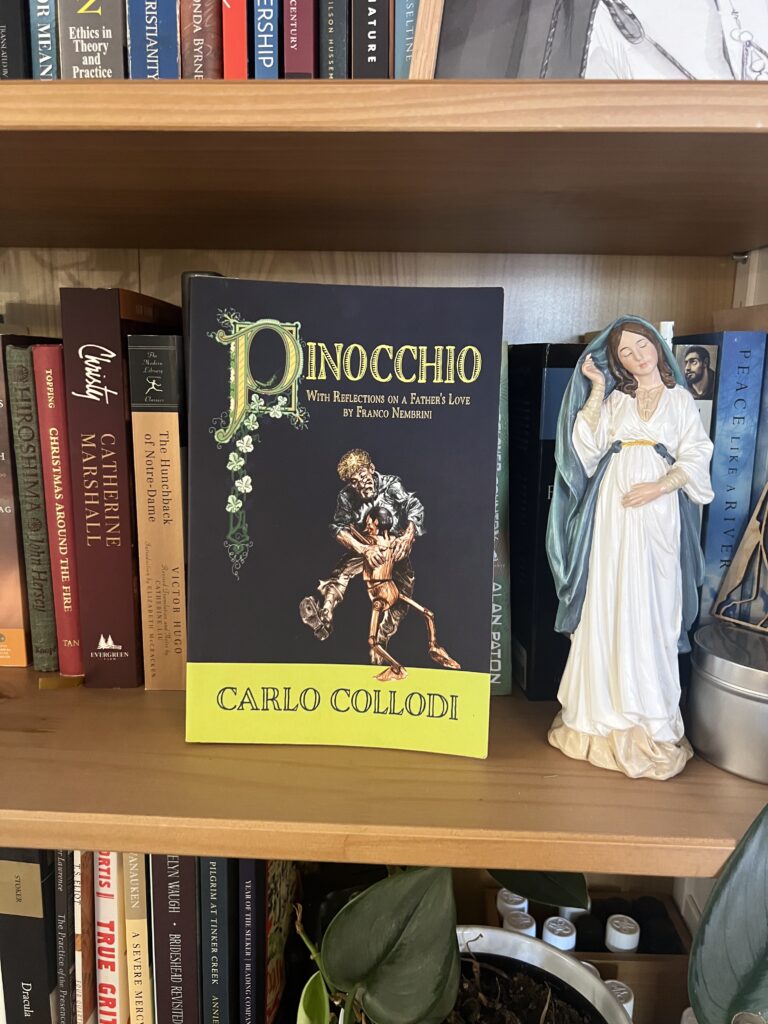
Pinocchio with Reflections on a Father’s Love was read in March 2025 during Well-Read Mom’s Year of the Father. You can view our free sample and purchase your copy here at The Well-Read Mom Store.
Several years ago, I began reading Pinocchio aloud to my boys. We got as far as the first encounter with the fox and the cat before I decided I would read no further. To this day, it is the only family read-aloud I’ve ever abandoned.
I suspected at the time that the fault was my own. I knew Pinocchio to be a beloved classic, and a brilliant friend delighted in reading it to her children. Yet, I dismissed it as being overly moralistic and unpalatably didactic.
And then, for the Year of the Father, Well-Read Mom partnered with Wiseblood Books to create a new edition with Franco Nembrini’s commentary, Pinocchio with Reflections on a Father’s Love. With this kind of support, I returned to the text I had abandoned.
One of the things I most appreciate about Well-Read Mom is that, thanks to the thoughtfully curated booklist, our discussions go beyond the typical book club talk of whether or not we like a book. We humbly acknowledge that the books selected are all worthy titles and that our personal taste has little to do with the goodness of the book itself.
That doesn’t mean that the goodness always comes easily. But I trusted from years of experience submitting to the Well-Read Mom reading plan that that there was blessing to be found in giving Pinocchio a second try. There certainly was.
I’ll admit: it took some work for me to get there.
I had to set aside my initial prejudices against the format and the way Nembrini’s reflections divide the Collodi’s text. I practiced hospitality and being open to Nembrini’s ideas and how he presented them. This was work for me as a reader, and it was well worth it.
My experience was not unlike what C.S. Lewis describes in Preface to Saint Athanasius’s On the Incarnation. “I believe that many who find that ‘nothing happens’ when they sit down, or kneel down, to a book of devotion, would find that the heart sings unbidden while they are working their way through a tough bit of theology with a pipe in their teeth and a pencil in their hand.”
I may not have been working through theology—and I certainly didn’t have a pipe in my teeth—but my heart did sing as I pondered these questions, and even more so when I was led to the marvelous conclusion.
In Nembrini’s final reflection on Collodi’s last chapter, he quotes Biffi, who wrote:
“Let me be perfectly clear that my intention is to leave Collodi precisely where he wishes to be… My intention has been merely to observe and exhibit the Father’s game, since He is pleased to load even the most despairing words with his message, even those which, at first glance, may seem unsuitable for and far removed from it.”
Suddenly, it became clear to me. The author of this story—every story, for that matter—is neither Collodi nor Nembrini, but God the Father himself.
Collodi may have wanted his story to end with the death of Pinocchio, but the story of the Father cannot possibly end there. In the original, serialized Pinocchio story, the children of Italy refused to let Collodi end the story where he wanted. Whether he wanted to or not, Collodi was required to give Pinocchio new life. Instead of death and despair being the end of the story, the Resurrection became the center in a structure that reflects the three moments of the history of the kingdom of God: Creation, Redemption and Parousia.
As He often does, God spoke through the voices of little children. And as He always does, God prevailed.
This unfolding occurred in my own family, too. Every night, I read aloud one chapter to my two younger sons. Then I would read Nembrini’s reflection for that chapter on my own, ready to start the next part of the story the following day.
I was left at the end of each chapter with much to ponder, and Nembrini’s ideas opened the story for me.
An unexpected fruit came as we read the penultimate chapter of the book two nights before the Solemnity of Saint Joseph, a fitting feast for the Year of the Father and especially for a book with a protagonist named Joseph (Geppetto). When Pinocchio follows the glimmer of light deeper into the belly of the dogfish and there finds Geppetto seated at the table, I, like Pinocchio “was filled with such great and unexpected joy” (323). I, too, wanted to laugh and cry, to revel in the goodness and forgiveness of the Father and to claim, along with Pinocchio, my identity as a child of God.
The next day, my five-year-old and I were out for a walk, and we began to talk about the book. His first comment was about how badly Pinocchio behaved, echoing what I had overhead his nine-year-old brother say once about how “Pinocchio was probably written to teach little boys not to be so naughty.” But I wondered if my son, like me, now had a deeper understanding of the book.
So, I asked him if Pinocchio was always bad. Right away he said “no.” He cited Pinocchio’s courage at walking out the mouth of the dogfish as it slept, leading Geppetto along as he went. I, too, loved this scene—for the reference to the stars and for the image of Pinocchio carrying Geppetto on his shoulders. The former reminded me of Dante (just as Nembrini points out in his commentary) and the latter of the Aeneid. But my son made an even more beautiful connection, likening this image to that of the Good Shepherd and the found sheep.
It is God’s brilliant humor that I experienced as I read Pinocchio with Reflections on a Father’s Love. If it weren’t for Well-Read Mom, I would never have tried to read this book again, and if it were not for Franco Nembrini, I would never have received so much from reading it.
Read more. Read well.

About Nicki Johnston
Nicki Johnston lives in Kansas with her husband, Graham, and their four sons. Together they homeschool, hike, camp, craft, square dance, and read many, many books.
About Well-Read Mom
In Well-Read Mom, women read more and read well. Our hope is to deepen the awareness of meaning hidden in each woman’s daily life, elevate the cultural conversation, and revitalize reading literature from books. If you would like to have us help you select worthy reading material, we invite you to join and read along with us. We are better together! For information on how to start or join a Well-Read Mom group visit our website wellreadmom.com