Virgil and the Work of Letting Go
Written by Nicki Johnston
When I began this Year of the Teacher, I was homeschooling all four of my sons without any intention of making any changes. We have homeschooled all along and planned to continue to do so, even as my oldest son transitions to high school this fall. He was thriving at home and so neither of us, or my husband, felt any desire or need to explore other options.
I have always considered my role as my sons teacher to be that of a guide. My job, I believe, is to introduce them to ideas and allow them to develop their own relationship with those ideas. I consider myself more of a co-learner than a teacher, and I have certainly learned as much as they have through these past eight years of homeschooling.
We spent his eighth-grade year reading, as we had done each year in our homeschool, and discussing good literature. While I didn’t assign him Purgatorio, he was very interested in it (just as Beth Anderson said that teens often are in her deep dive interview). And so, I would share with him what I read in my daily canto. When we had time alone in the car together, we would listen to Anthony Esolen’s lectures about the poem.
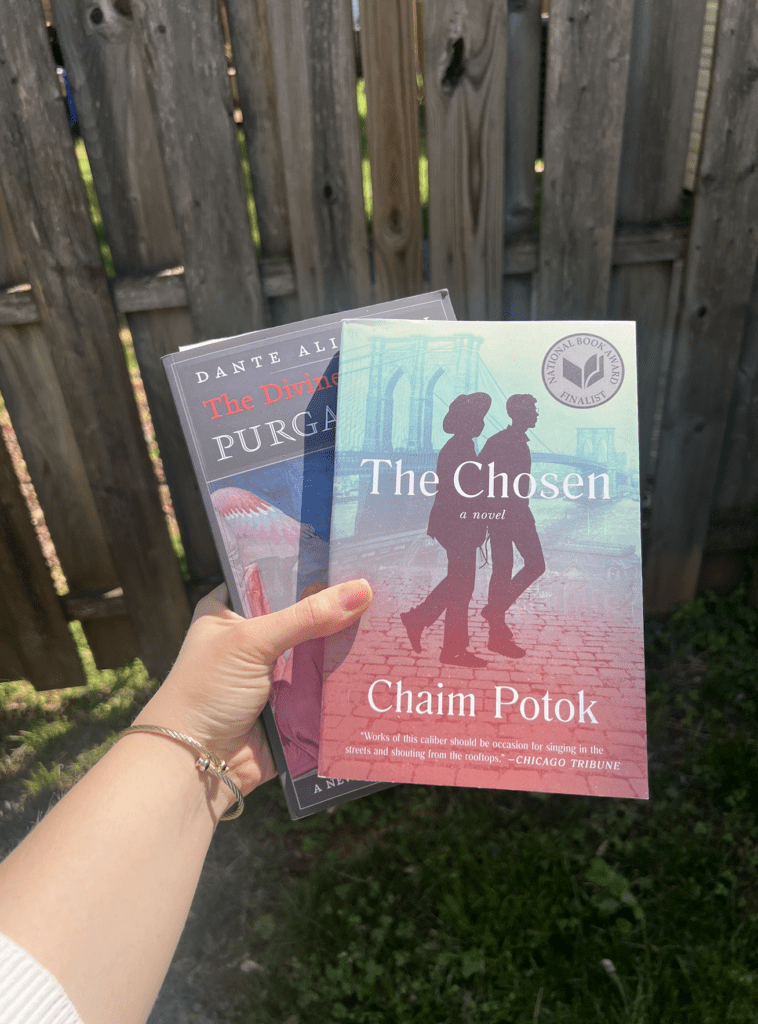
I read the Divine Comedy once before (alone and over the course of three years fairly early into my homeschooling journey) using Esolen’s translation. I’ve enjoyed reading Jason Baxter’s new translation this time but have occasionally grabbed the old copy off of my shelf to read through Esolen’s helpful notes. One such time was Canto 25.
Confused about what was happening in this canto, and struggling to understand it without more context, I turned to the end notes in Esolen’s translation to read, “No one’s favorite canto, this, not poetic enough, what with all that embryology and metaphysics.” After laughing aloud, and feeling validated in my confusion, I went on to read a helpful explanation of the themes of faith and reason that Dante is exploring in Canto 25.
What stood out to me the most, though, was a note about Virgil. The character who I had seen, particularly through the lens of this year’s theme, as Dante’s teacher throughout his journey, was now deferring to others (here, Statius). Esolen writes, “Throughout the Purgatorio, Virgil too has had to learn: though he reveals to Dante those features of Purgatory that are accessible to reason, he receives his own instruction from various sources: The realm attenuates Virgil’s role as Dante’s instructor, as both he and Dante more and more consistently turn elsewhere for knowledge. This process reaches its culmination at the top of the mountain, where Virgil listens in grateful and wondering silence” (Esolen, 474)
Next to this note, I had written my own: “Virgil is like a homeschooling mom” teaching what (s)he can but also learning “in wondering silence”alongside.
As I read Purgatorio during this season of Lent, I felt myself invited to consider my own attachments and ask myself what I am being invited to let go of. Through much prayer and reflection, and with the help of Dante and Virgil, I came to realize my own attachment to homeschooling.
I didn’t want my son to go to high school because I wanted things to stay just as they were. I didn’t want our cohesive unit to be split up. I wanted to keep learning alongside my son and reading with him. I was struggling to let go of my identity as a homeschooler just as much as I was struggling to let go of him.
Looking to Virgil as an example, I began to consider whether it might be time for me to attenuate my role as his instructor and encourage him to turn elsewhere for knowledge for this next part of his educational journey. And so, we applied to the local Catholic classical high school (where, of course, they read Dante).
Thankfully I will not completely disappear as Virgil so sadly does in Canto 30. My husband and I are still his primary educators, and my son and I plan to continue our mother-son book clubs (though less frequently, I’m sure).
In fact, three days after we learned of his acceptance, he and I went to our favorite Mexican restaurant to talk about The Chosen over chips and salsa. It was the perfect book to read and discuss with my fourteen-year-old son as we both look ahead to his next step in his education. We had a wonderful conversation about learning, reading, studying, censorship, discerning one’s vocation and what it means to choose and be a friend.
I am confident that these conversations will continue, despite the changes we’ll experience this coming school year. I will continue to homeschool my other sons, perhaps with more awareness of the preciousness of this fleeting time together. I’m thankful for good literature to help form myself and my children, and I‘m especially grateful for this Year of the Teacher, so aptly timed for my own personal journey.

About Nicki Johnston
Nicki Johnston lives in Kansas with her husband, Graham, and their four sons. Together they homeschool, hike, camp, craft, square dance, and read many, many books.
About Well-Read Mom
In Well-Read Mom, women read more and read well. Our hope is to deepen the awareness of meaning hidden in each woman’s daily life, elevate the cultural conversation, and revitalize reading literature from books. If you would like to have us help you select worthy reading material, we invite you to join and read along with us. We are better together! For information on how to start or join a Well-Read Mom group visit our website wellreadmom.com