Education & Teachers: A conversation with G. K. Chesterton Scholar Dale Ahlquist
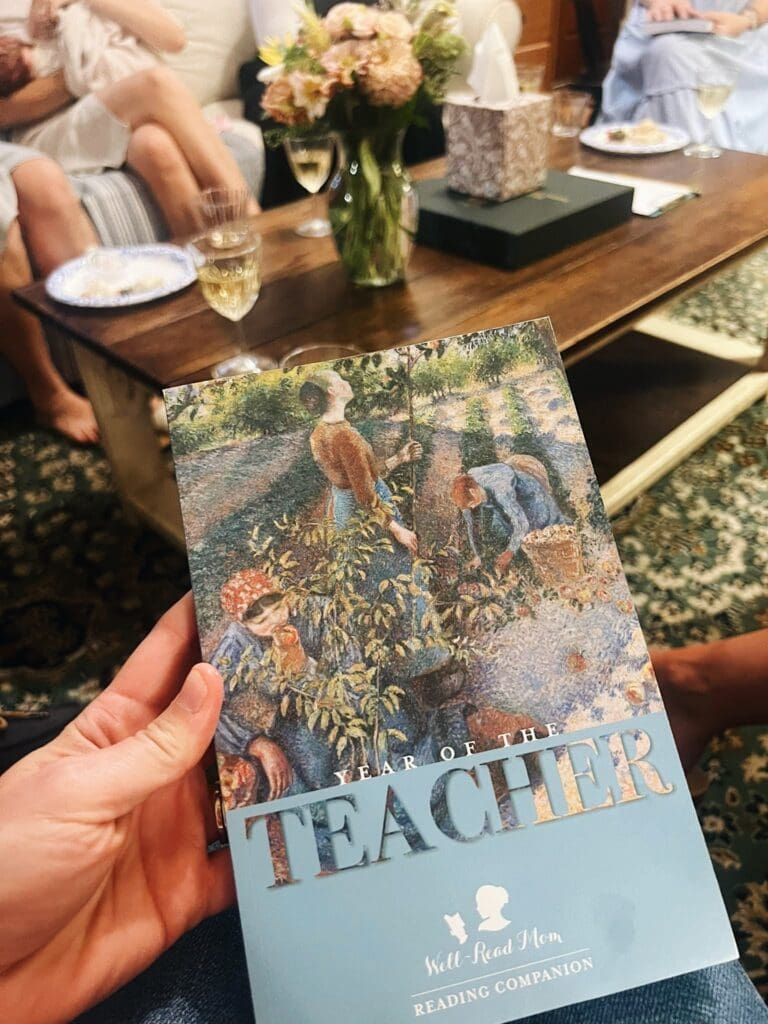
To cap off our Year of the Teacher, we feature a conversation between Marcie Stokman, Colleen Hutt, and Dale Ahlquist, president of the Society of Gilbert Keith Chesterton. Ahlquist is also the co-founder of the first Chesterton Academy, a classical high school in Hopkins, Minnesota, which gave birth to the growing Chesterton Schools Network of more than seventy schools in the United States and nine other countries.
Marcie Stokman: How do we learn? How do we teach? For all of us, teaching and learning are part of our lives. This year in Well-Read Mom, we looked at teaching from many different aspects. What do we learn in community? What do we learn from architecture? What do we learn from nature? How does reality teach us? So Dale, can you get us started with answering this question? First of all, what is a great teacher? What makes a great teacher?
Dale Ahlquist: Chesterton defines education as simply truth in the state of transmission. It’s passing the truth from one generation to the other. That’s what the definition of education is. Well, who is the one who does the actual passing of the truth? It’s the teacher. And the teacher, course, in a school setting is in loco parentis, in the place of the parent. They’re working not really for the student, but for the parent, representing the parent in the classroom. Knowledge is not just facts. It is learning a whole view of the world. The teachers, they’re reinforcing a view of the world that the parent is trying to convey and give to their child. I think, you know, the role of the teacher, has a certain solidarity. Also, you know, every teacher is as different as every human being. It’s like every daisy and every snowflake is different. Every teacher is different.
MS: You mentioned G.K. Chesterton, and that’s the name of the schools that you founded. Who was GK Chesterton? What captivated you so much about him? What would he say is the purpose of education?
DA: Well, Chesterton is an early twentieth century intellectual and a very famous Catholic convert from England. He was one of the formative forces behind C. S. Lewis. C. S. Lewis really became a Christian as a result of reading Chesterton and got a lot of his ideas from Chesterton. And a lot of people who read Chesterton, as is what happened with me, become Catholic. He has a way of converting people when they read him. But he also brings this tremendous joy and this view of the world that is just imbued with thanks and wonder. And that’s one of the great attractions about him as well.
We chose Chesterton as the patron of the school because he does represent a complete thinker, someone who really has a broad and profound and integrated understanding of the world. We want to give that same complete thinking package to our students, and that’s why he’s the natural patron of the school. Plus, he’s joyful. Everyone who attends our school, everyone who visits our school, is impressed by the joy in the students and the laughter in the hallways. His approach to education is that it’s truth in the state of transmission. Also, it is clearly the number one responsibility of the parent. It’s the parent that hires the teacher. The teacher answers to the parent. And this school is for parents. You never step away from that reality.
MS: When Colleen and I visited your school, we noticed that joy. It was so palpable. All the kids knew you, Dale, and you knew all of the kids. There’s something about the affection that you have for each other that makes a teacher a believable witness. I’m wondering if you could speak to that a little bit? This sense that the teacher can only transmit truth if the student has true affection. How do you create that? How do you instill that? How can we live that better as women in our homes?
DA: We try to make it a point of our teacher education, our teacher training, that you have to let that student know that you love them. And they will know if you do. Once they understand that you love them, they’re going to treat you with more respect and understand your authority, that you’re there for their good because you love them. And that is, I think, one of the great formulas for success at our schools.
You have teachers not only invested in their vocation, but they’re literally invested in the students in terms of investing in their souls.
Colleen Hutt: I agree with that. We accept correction when it’s based in love. Thinking of my favorite teachers, the ones who I learned from were passionate about their subject. They were curious and in wonder. I joined in with them in this passion. And that’s when learning happened. What roles do wonder and curiosity have in the teacher-learner relationship?
DA: Every subject should be just sparking the curiosity and awe of a student. Part of the role of the teacher is to make that sense of wonder palpable in the classroom. The reason why people love mystery stories is because they want to know how this is going to end. They want to know what the solution is. Chesterton is such a good writer because everything is leading to a solution and you’re anxious to find out what it is. Well, that’s the sense you want to put into the classroom. Today’s a detective story and let’s see if we can solve the problem. You’re doing that whether you’re studying calculus or geometry or philosophy or a book, a work of literature. How is this going to get resolved? Everybody should always be on the edge of their seats.
MS: When I was visiting you at the Chesterton School, I saw a woman sitting on a chair reading one of our books that we were reading in Well-Read Mom: My God And My All. I started chatting with her. She was in a Well-Read Mom group. I thought, how wonderful that there’s a Well-Read Mom group here because these women are modeling. They’re taking part in leisure. They are part of this kind of growth in goodness, truth, and beauty, this kind of increasing wonder about why we’re here and what life is about, and how do I live my life well? I’m thinking many women, myself included, didn’t have this kind of education. What would you say to us?
DA: One of the great reactions we’ve seen from parents throughout the history of our school is the parents want the same education that their child is experiencing. So any way they can, they’re trying to experience it along with them. These kids are all getting the high school education that all of us wanted and didn’t get. I think it’s just great when mothers are inspired to pick up the same books that their children are reading. Because not only are they going to share that experience with their children so they can discuss the books, but they’re going to be enriched themselves. That’s going to have a long-term effect. Chesterton has a beautiful description of women where he says that they’re like towers with many windows. And I think that as women help the child see more, they expand their own view.
MS: In Well-Read Mom, we are encouraging one another to take a step, to raise the bar, to do what you can, but stay together. And boy, it is a source of leisure, leisure in the generative sense. Can you speak about Chesterton and leisure? How did he experience leisure?
DA: [Some think of] Chesterton as this large, life-enjoying guy, someone who just was sitting around, right? But he was always working. True, he’d go to the pub and write, but he’d be writing. He’s working. His mind is engaged. And mental activity is just as vigorous and tiring as physical activity. And he was always engaged. And he said, “I never have enough nothing to do.” Because he just craved a time when he didn’t have to do anything else.
Well, he did have those times. Once a year, he would go on a two-week vacation, you’d say holiday in England, and go usually to a seaside resort. People would describe seeing him. He’d be parked on the front porch of an inn in the same chair every day and have two piles of books on either side of him. He didn’t have to do any writing at all. He was just reading and just taking things in and they could tell. It was an absolutely blissful view of Chester. We need those times where we just shut everything out and what we should do is read because that’s what we don’t do enough of. We spend too much time on the screens and that’s a different mental experience than reading a book.
MS: I think, why do we want to be educated? In part, I have this deep desire, and I’m sure both of you do, too, and all the women reading, to live the truth of our lives, right? We don’t want to go through life and miss out on the main thing. And we know that the main thing, as Christians, is growing in holiness. Becoming who Jesus, who the Lord wants us to be, in union with God. Can you speak to how education helps in that?
DA: The purpose of every artistic experience, but also of every mundane practical experience, is to draw us closer to God. Everything in our lives is supposed to draw us closer to God. If it doesn’t, it’s doing the opposite; it’s drawing us away from God. So the purpose of education is to draw us closer to God. The reason we read a book is ultimately to be drawn closer to God. We continue the lifelong education because the more our minds expand, the more we can be grateful for the great gifts that God has given us. Chesterton says, “Thanks is the highest form of thought.” So the more that we have in our brains, the more we are aware of, that means there’s more to be thankful for.

About Dale Ahlquist
Dale Ahlquist is president of the Society of Gilbert Keith Chesterton. He the creator and host of the EWTN television series, The Apostle of Common Sense. He’s also the author of eight books, the editor of sixteen more, and publisher of Gilbert Magazine, co-founder of the first Chesterton Academy, a classical high school in Hopkins, Minnesota, which gave birth to the growing Chesterton Schools Network that now includes more than seventy schools in the United States and nine other countries.
About Well-Read Mom
In Well-Read Mom, women read more and read well. Our hope is to deepen the awareness of meaning hidden in each woman’s daily life, elevate the cultural conversation, and revitalize reading literature from books. If you would like to have us help you select worthy reading material, we invite you to join and read along with us. We are better together! For information on how to start or join a Well-Read Mom group visit our website wellreadmom.com