Is Reading Literature Scandalous?
Written by Colleen Hutt, Well-Read Mom Director of Literary Evangelization
Well, it can be. It all depends on the what and the how– what kind of literature one reads and how one understands it. The word “scandal” has a rich etymology, coming from the Greek skandalon which means a trap, or stumbling block. In his Letter to the Corinthians, St. Paul says, “We proclaim Christ crucified, a stumbling block (skandalon) to the Jews and foolishness to Gentiles, but to those who are called, both Jews and Greeks, Christ the power of God and the wisdom of God.”
The Cross was a scandal because it defied what both Jews and Gentiles expected. It was a stumbling block to their common understandings of power, glory, and wisdom. How could grace come through violence? How could a king be crucified? Yet the Cross ultimately reveals a deeper truth: we cannot understand redemption by ignoring sin but only by passing through it and seeing its consequences in the light of grace. We cannot tell the story of the Passion by skipping over Good Friday. Similarly, we can’t tell the story of man authentically without showing him in all his desires, hopes, fears, joys, longing, and sin. Literatures craft lies in showing life compellingly richly descriptive and authentically human.
Stories often confront us with sin, weakness, and moral failure. Can these depictions be a scandal, a stumbling block, for us? The answer lies not in whether literature depicts sin, but whether it reveals the truth about it. If a story depicts sin as neutral, ambivalent or something to desire, then it might be a stumbling block, a scandal.
Many books today depict vice and sin as attractive or trivial, masking the deeper cry of the human heart. They often rest on ideologies that treat truth, goodness, and beauty as entirely subjective, leaving ultimate questions of meaning unexamined. Spiritual realities are reduced to abstract ideas or ignored entirely. In response, there is also a temptation toward “safe literature” works that depict only what is obviously good, true, and beautiful, while avoiding the complexity of human freedom, moral struggle, and evil. As St. John Henry Newman warns, when we fail to show humanity as it truly is, we produce something other than literature.
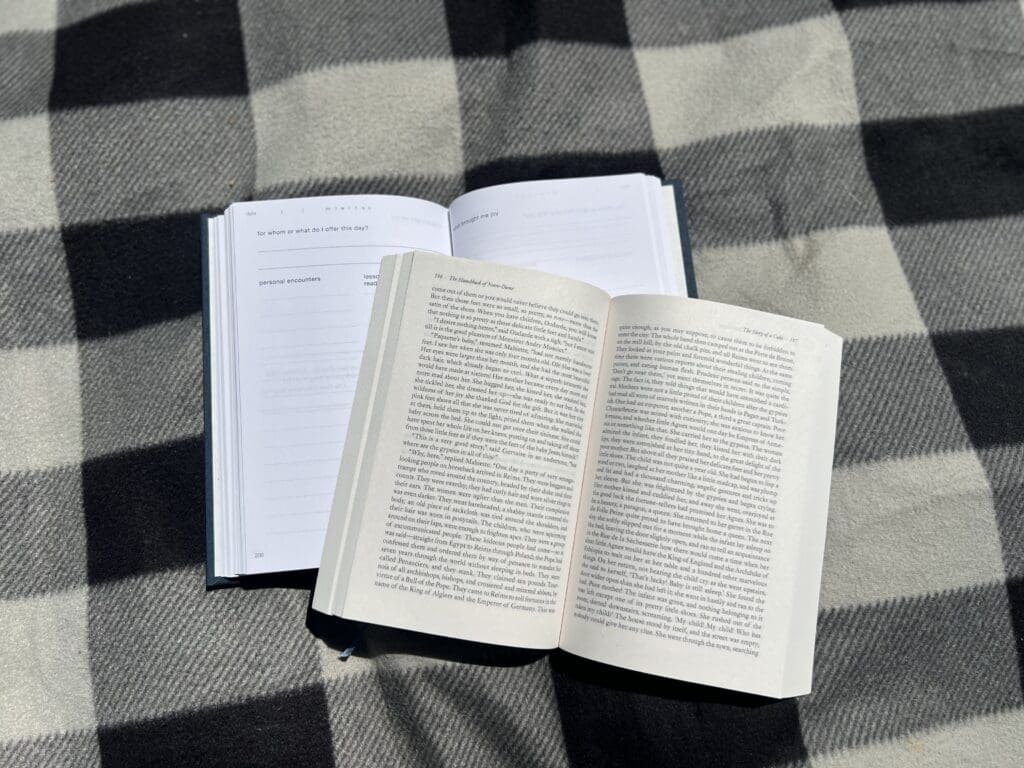
Newman writes in The Idea of a University that literature is the science or history, partly and at best of natural man, partly of man in rebellion. He argues that attempts at a purely Christian literature are misguided:
It is a contradiction in terms to attempt a sinless literature of sinful man. (Idea of a University, 174)
We read literature, then, not to avoid sin, but to better recognize its presence in our own lives. Fiction creates a space between reality and imagination, allowing us to examine human choices and ask whether they align with truth. For Christians, this lens allows literature to illuminate how we might live more fully. In Well-Read Mom, this is what we mean by reading literature through the lens of the Catholic intellectual tradition. We choose books that allow us to see our own need more clearly. Like Jesus, we are not scandalized by the existence of sin; rather, we are scandalized when we choose to remain in sin or rationalize why sin is not really sin. That is the real scandal, the real horror.
Reading does not make one virtuous, though we hope that might be one of its fruits. One reason we read is to encounter human behavior as it actually is, to discern ”through imagination” what we ought to do if placed in similar circumstances. Literature allows us to confront weakness, moral failure, and the consequences of sin in a space that trains the conscience and imagination. It also allows us to pay attention to beauty, to recognize the operation of grace often unnoticed in our break-neck paced lives.
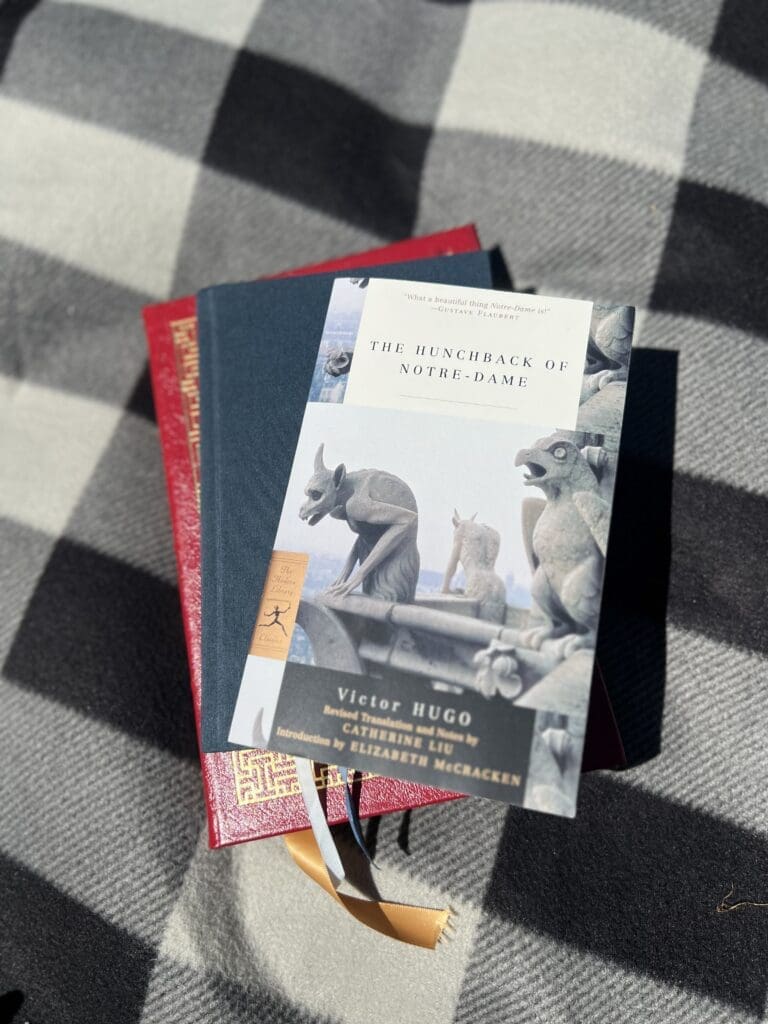
For example, in The Hunchback of Notre Dame, we encountered Claude Frollo, who does not live up to his vocational calling as a priest. We cannot deny that there have been and still are clergy who do not live up to their true vocation. This fact takes nothing away from the great majority of priests who have lived heroic lives of virtue and grace. Yet Victor Hugo does not hide Frollo’s fall.
As Frollo falls from the bell tower, there is a moment when he catches himself on the ledge and looks up at Quasimodo. This is the moment when he could bring his life into focus and repent of his sins. Instead, he clings to them to lust, to the finite things of this world rather than turning toward God.
Frollo’s final fall stands in stark contrast to Buonconte da Montefeltro in Dante’s Purgatorio. Buonconte lived a sinful life and died on the battlefield, yet in his final breath he managed to utter the name Mary. The demons rage that such a last-moment cry can lead to salvation. These scenes, in all their vivid detail, burn into the imagination an image of how to die and how not to die.
That is literatures power: it shows the consequences of human actions. Frollo’s death scene makes me want to ask forgiveness now. Hugo leaves an imprint on my imagination of what I do not want the end of my life to be, and for that reason it makes me long for what is truly good.
This is what we call learning through the via negativa, the negative way. We can learn how to be good from a bad example. When a story is crafted with artistic integrity, the author gives us just enough of the via negativa without becoming gratuitous or graphic. We realize that everyone’s threshold for what they consider graphic is shaped by personal experience and sensibilities, and a person may choose not to read a novel for a reason, but that does not mean certain literature should not be read simply because it portrays sin.
Reading St. John Henry Newman, a Doctor of the Church, helps me not be afraid of literature even when it challenges me because reading literature is a training for life. Flannery O’Connor is often misunderstood as merely a writer of violence and the grotesque. While her stories may not resonate with all readers, she once wrote:
[My] stories are hard but they are hard because there is nothing harder or less sentimental than Christian realism. I believe that there are many rough beasts now slouching toward Bethlehem to be born and that I have reported the progress of a few of them, and when I see these stories described as horror stories I am always amused because the reviewer always has hold of the wrong horror. (Flannery O’Connor, Mystery and Manners, 117.)
The real horror is sin, unrepentance, spiritual blindness, and resistance to Grace, and good literature artfully puts these realities into focus for us.
At Well-Read Mom, we are often asked how we choose the books for the reading list. The process is both thoughtful and organic shaped by prayer and discernment, providential twists and turns, relationships with authors and professors, studying classic reading lists, and the recommendations from our members. We are intentional about selecting literature that is neither ideological nor propagandistic, but instead opens up the real questions of our lives with depth and staying power. We work diligently to provide a balanced experience every year from meditations on both struggles and joys.
We deeply value the trust you place in us to curate each year’s list with care and attentiveness. Our hope is to bring stories into your lives that enrich the moral imagination and accompany you on the path of wisdom.
For further education on this topic, may we suggest:
- Newman, John Henry. The Idea of a University. University of Notre Dame Press. (See especially the discourse Duties of the Church Towards Knowledge.)
- Francis. Letter on the Role of Literature in Formation. Vatican, 2024.
- Gioia, Dana. The Catholic Writer Today. Wiseblood Press.
- Hren, Joshua. How to Read (and Write) Like a Catholic. TAN Books.
- Hren, Joshua. More than a Matter of Taste: On Aesthetics, Form, and the Catholic Imagination. Word on Fire Academic.
- Leigh, David, S.J. Why Read Literature? Dappled Things.
https://www.dappledthings.org/nonfiction/11152/why-read-literature - Flannery O’Connor, The Fiction Writer and His Country
- Nelson, Cassandra. A Theology of Fiction. Wiseblood Press.
About Colleen Hutt
Colleen Hutt graduated from the University of Notre Dame’s Program of Liberal Studies. She has worked as a Director of Religious Education in Venice, FL and as a Pastoral Associate for Adult Formation in Whitefish Bay and Fox Point, WI. She and her husband, Colin, have five children and one grandchild. She is an active parishioner of St. Monica Parish in Whitefish Bay. She continues to help with adult and youth formation, Eucharistic Adoration, leads Church tours, contributes to St. Vincent de Paul meal program, mentors engaged couples and is passionate about supporting the Women’s Care Center in Milwaukee. She leads two Well Read Mom groups currently and serves on the WRM national committee and is the WRM Director of Pilgrimage. She loves learning and growing in her faith and tries to approach the struggles of modern life from the heart of the Church.
About Well-Read Mom
In Well-Read Mom, women read more and read well. Our hope is to deepen the awareness of meaning hidden in each woman’s daily life, elevate the cultural conversation, and revitalize reading literature from books. If you would like to have us help you select worthy reading material, we invite you to join and read along with us. We are better together! For information on how to start or join a Well-Read Mom group visit our website wellreadmom.com